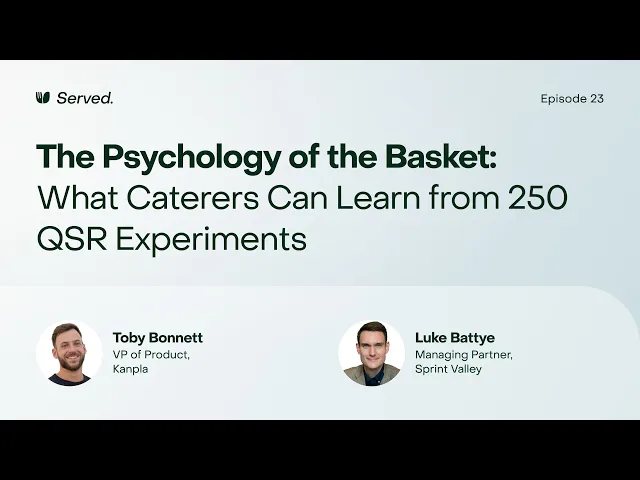
In this Served. episode, we sat down with Luke Battye, founder and managing partner at Sprint Valley, a consultancy that uses behavioural science to grow digital revenue for food brands. Over the past decade, Luke’s team has run more than 250 revenue experiments for some of the world’s top 10 QSR brands, in markets from Korea and Australia to Canada, the US, Europe and the Middle East.
His world is fast food, but the parallels for caterers are hard to ignore. As host Toby Bonnett put it, many operators are moving straight from a till and a cash drawer to apps and kiosks, mainly for operational reasons, and then leaving the setup untouched. The second wave of digitalisation is about what those screens do to revenue, margin and satisfaction. QSR is already there, and Luke has spent ten years learning what works.
The hungry brain takes shortcuts
Luke describes himself as a geek about why people do what they do, and a food lover on top of that. He opened with a test. Dogs or cats? Toby answered instantly. Then: what is 7.23 times 4.22? The pause that followed, Luke said, is the feeling of calories being burned.
That is the difference between system one thinking (fast, automatic, effortless) and system two (slow, accurate, expensive). Humans evolved where calories were scarce, so we default to system one wherever we can. Most businesses work against this by adding complexity, confusion and hesitation. Sprint Valley’s job is the opposite: make every choice feel easier.
And food adds a twist that no other category has to deal with:
Every unnecessary decision on a screen spends from a budget that was already low when the customer walked in.
Why £19 beat £18.99
One of Sprint Valley’s first experiments, nearly ten years ago, involved a product priced at £18.99. The team raised it to £19, and sales went up by somewhere around 10 to 15 percent, possibly more by Luke’s recollection. The explanation is syllables. Eighteen ninety-nine has five, nineteen has two, and the shorter number felt smaller and simpler to process.
Toby pointed out that operators have always been told £5.99 reads as better value than £6. Luke isn’t dogmatic either way. Charm pricing can absolutely work, which is exactly why you test. His point is that value is a perception, not a calculation:
People use whatever is in front of them to make that judgement, and the operator controls most of it.
Nobody is managing the basket
Price is just one of those cues. Luke’s diagnosis of QSR right now is blunt: customers are more price conscious than ever, and most brands don’t realise how much the way they present a menu shapes what gets added to an order.
As Luke sees it, the industry tracks the outcome and ignores the mechanism:
He is careful about the limits. You can’t make someone buy something they don’t want, or spend money they don’t have. What you can do is get out of the customer’s way, and stop putting them off things they were already half considering.
He thinks of a meal as six slots in a tray: main, side, drink, extra side or flavour, sauce, dessert. Read the basket, find the empty slots, and recommend what fills them. Nobody with a burger already in the cart needs a second burger suggested.
The FEAST framework by Sprint Valley
Sprint Valley’s work reaches around 200 million consumers a year, across EMEA, APAC, the South Pacific and the Americas. At that scale, the same handful of patterns keep showing up wherever guest spend grows. Luke’s team packs them into one word: FEAST.

FEAST™ by Sprint Valley - a behavioural framework for digital revenue growth in QSR
Luke breaks down each letter below
Focus is about simplifying and guiding. On a kiosk with 30 to 50 products across up to ten categories, the work is deciding which category to start customers in and which products deserve visual priority. Transaction data shows what is both popular and commercially healthy, and that is where attention should go.
Explain is about making value explicit wherever there is a choice: a size, an offer, a price. In a recent audit, a major brand showed small, medium and large meals with full prices and identical images, leaving price as the only cue. Another Sprint Valley client is now adding protein content to the decision, giving customers a reason why one option costs more than another.
Adapt is the lever Luke calls the most underused. Long before one-to-one AI personalisation, there is time of day, location, eat-in versus takeaway, and what is already in the basket. In a workplace restaurant, the case is even stronger. Someone coming in at 11am is on a completely different mission from the lunch crowd, yet most screens treat them exactly the same.
Sequence treats customer decision-making as a budget to be managed. A common mistake is listing the à la carte burger and the meal version on the same page, forcing two decisions at once. Splitting them into separate steps adds a click to the journey, yet across several markets Sprint Valley has seen transaction time stay flat while baskets grow. People rarely skip an add-on because they don’t want it, but because the choice feels like too much work.
Tempt sounds obvious, but Luke insists most brands still miss it. The job is to make it easy for someone to imagine enjoying the product, through photography, video or the description. His favourite example is dips. Most brands show the packaging, while Domino’s shows chicken going into glistening sauce.
Dips are also low cost and need no prep, so getting another 5 percent of customers to add one is a material gain over a year.
Faster queues, not just bigger baskets
FEAST doesn’t have to be about selling more. For a caterer whose whole day is decided in a 45-minute lunch peak, the goal might be speed. Luke’s approach is to rank every product by popularity and by operational complexity, then use the same levers to steer customers towards the dishes people love that are also quick to produce.
Then there is the other half of the equation. Disney tells guests a ride queue will take longer than it actually does, so the wait feels better than expected. A wait also feels shorter when you’re occupied, and shorter again when you know how long it will be. As Luke framed it, operators have two levers, not one:
Toby summed it up as satisfaction being the gap between what you expected and what you got.
How to run experiments
Every FEAST opportunity starts as a hypothesis, and Luke is clear that hypotheses are often wrong. On Uber Eats, a QSR client’s marketing team had picked the product for its buy-one-get-one-free offer. When Sprint Valley tested alternatives, the original choice converted 13 percent worse than the other options. That, for Luke, is the whole argument for testing:
The method is a pilot with a safety net. For an operator with 100 sites, that might mean 20 sites for two to three weeks. At each site, one kiosk runs the current setup and another runs the change, and the data from both is compared statistically.
If the result holds, it scales to 50 sites, then 100. A good hit rate is around 40 percent. A test that lifts average check but also slows down ordering goes back for refinement before it reaches the queue.
The unexpected benefit is cultural. Ideas that would feel too risky across the whole estate become easy to try on a handful of sites for a few weeks, so teams get bolder and test more.
Putting it to work in contract catering
Toby put a realistic brief to Luke: a regional caterer with 100 restaurants in London, a mostly fixed customer base, menus that vary by client, and a goal of higher average spend without hurting participation. Luke’s first move was to challenge the goal. Revenue can come from frequency as well as average check, so he would want to know which route is actually open.
Then comes a basket analysis of six months of transactions: how many of the six slots are being filled, and how that varies by month, day part and site. He expects a Pareto pattern, with 20 percent of the menu driving 80 percent of revenue, overlaid with where the margin actually sits. His point to caterers is that the raw material is already on the books:
That analysis often reframes the brief. A caterer chasing a bigger lunch basket might find the real gap is mid-morning or breakfast, when a large share of the building simply isn’t coming in. That is a frequency opportunity, and no amount of upselling at lunch will find it.
A FEAST audit then produces 15 to 20 opportunities, each given a revenue value. Quick wins go first: imagery, merchandising and sequencing changes that need no new development. After two to three weeks live, the results come back. Of five tests, three might work and get scaled up, while the other two are reworked or retested. Over time, the history becomes a living map of what works for that operator.
Great at goodbyes
Getting people to come in four days a week instead of three is a different problem. Luke would start by profiling frequent visitors against infrequent ones, through interviews and surveys, and accept that the answer may not sit in a digital channel at all.
He shared a project for a global QSR brand in India that looked at what predicted a return visit within four weeks. The key was the peak-end rule: people judge an experience by its most extreme moment and how it ended. In 25 percent of cases, customers visited the bathroom on their way out and found it dirty or the bins overflowing. A change to cleaning routines brought an additional 1.4 million visits over the following year.
For an industry that naturally obsesses over the plate, Luke’s advice is to look at the last moment too:
Toby, who once ran a full-service restaurant, added that payment is the stage where you can only lose. Luke agreed: some moments should simply be forgettable.
What comes next
Luke expects AI to make personalisation easier and testing cheaper to run at scale. Today, surprisingly few brands invest in proper experimentation programmes, and the ones that do are growing faster. For large organisations, sharing what they learn between markets could be a major accelerator, and Luke is clear about who owns those results:
On recommendation engines, Luke noted that many look at a 30-day window, while Sprint Valley analyses 12 months to capture longer-range trends. Toby offered a counterpoint: Kanpla’s own engine for mobile ordering deliberately uses a shorter window, on the basis that a purchase three months ago may no longer reflect what someone wants. It is a debate worth continuing.
The bigger shift is access. Analysis that once required a data team is becoming available to operators of any size, which means a regional caterer can now ask the same questions as a global QSR brand. A kiosk that went live two years ago and hasn’t changed since is not a finished project. By Luke’s count, it is 15 to 20 untested opportunities, sitting in data the operator already owns.
Want more from Luke?
Luke and the Sprint Valley team publish Brain Food, a LinkedIn newsletter on the psychology of digital revenue in food. It’s the place to go for more experiments, examples and before-and-after comparisons like the dips. You can also follow Sprint Valley on LinkedIn for their latest work with QSR and foodservice brands.
Watch the full episode
Keep Reading

Episode 23
The Psychology of the Basket: What Caterers Can Learn from 250 QSR Experiments

Episode 22
Fight for Every Euro: Alexander Breuckelmann on Running 600 Restaurants with a Retail Mindset

Episode 21
What Contract Catering Can Steal From the High Street: Chris Fletcher on Tech Stacks, Loyalty and AI

