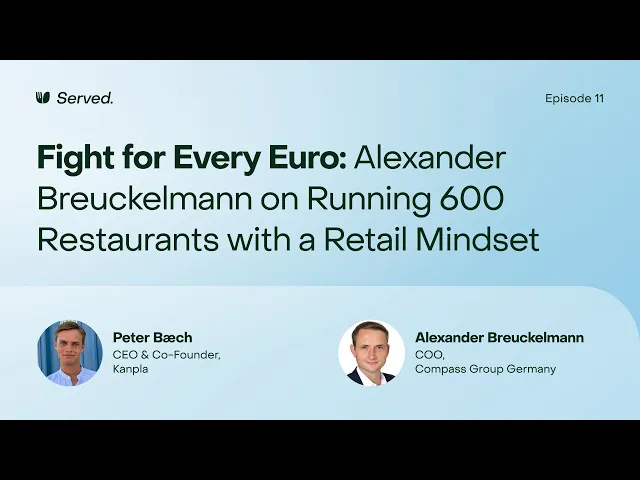
Fight for Every Euro: Alexander Breuckelmann on Running 600 Restaurants with a Retail Mindset
Episode 22

Fifteen years ago a Lidl sold you bulk. Today it sells you a croissant and a coffee on the way in.
Alexander Breuckelmann thinks that is one of the more consequential things to happen to workplace catering in a decade, and that most of the industry is still not counting it as competition. He has been COO of Compass Group Deutschland GmbH for a year: roughly 600 restaurants, 800,000 guests a week. Before this he was at Selecta, before that he ran operations and the franchise business for Burger King Germany, and before that he grew up commercially inside Lidl, starting in logistics.
In a sector where most senior people have spent an entire career under one roof, he reads the market with retail and QSR eyes. It produces a noticeably less comfortable diagnosis.
The competition is not the caterer down the road
Contract catering usually names its competitive set as other caterers, delivery apps, and the fridge at home. Breuckelmann names the supermarket.
Add frequency retail at stations and airports, plus a growing vending footprint, and the effect shows up in Compass's own site data. Where retail sits close to a building, capturing everyone who works in it gets measurably harder.
His response is not to defend the lunch hour. It is to go after everything around it. If a guest buys a Coca-Cola Zero on the way home, the question is why they are not buying it from the restaurant they walked past. If they want a sushi box to take home so they can skip the convenience shop on the corner, that is revenue currently being left on the pavement.
Which reframes the whole opportunity. The untapped territory is not lunch. It is the hours either side of it.
Two ways to grow, and one of them is closing
The arithmetic underneath that is blunt. There are two levers on revenue: more guests, or a higher spend per guest. In Germany, the first one is getting harder to pull.
Automotive is under visible strain, and so is the supply base feeding it. AI is expected to take a bite out of office headcount. Return to office policies push the other way, but nobody can size that yet. Breuckelmann does not pretend to know how it nets out. What he does have is the number already in the building: 800,000 guests a week across Germany, and an open question about how much more of their spend Compass can earn.
That is the sentence that separates an operator who came up through catering from one who came up through retail. In a subsidised canteen, footfall arrives. In a Lidl, nothing arrives.
The trade-off that stopped being a trade-off
Standardisation and customisation used to be a real trade-off, and the reason was purchasing. Identical menus meant volume, and volume meant buying power. Scale required flattening the offer.
That constraint is dissolving. Spend can be aggregated across an estate without the menus being aggregated, which turns an either/or into a dial. The client sets the level, anywhere from the Michelin star restaurant Compass runs in Frankfurt to a production line canteen built for throughput.
His strongest argument for standards has nothing to do with clients.
Standards as a hiring story, not a margin story. The two he makes mandatory, waste tracking and a non-dairy option, cost clients nothing they were buying. Where a market leader would refuse one goes unnamed, which makes the next problem much harder.
Made to order is the admission
Asked what the industry has not solved, he does not soften it.
At Starbucks, McDonald's and Burger King, on his account, seventy to eighty percent of items are customised. Made to order is not a feature there. It is the default.
The blocker is the peak: a workplace restaurant compresses its demand into sixty minutes. But the expectation has arrived regardless, and Compass can see it. Around 700,000 guest feedbacks a year across the German estate, with value for money the loudest theme after 36% food price inflation in five years.
What he does not say is what Compass is testing, which leaves the sharpest admission in the conversation without a second half. It still stands. Few people running a national market will say on record that their industry has not cracked what QSR cracked years ago.
600 restaurants, 600 owners
Compass will most likely never franchise. But the franchise mindset is the thing he wants to import, and he is specific about what it looks like on the floor: a manager at the door, welcoming guests into a restaurant they think of as theirs, serving food they think of as theirs.
The contrast with Burger King is where it gets sharp. There, he never had to tell an operator how to improve their experience or their profit. They came to him asking what else they could do. Ideas travelled up instead of instructions travelling down.
The mechanism is where it stops. Enablement here means training, standards where they help, and buying power. All real, all useful, none of them the thing that actually makes a franchisee behave like a franchisee, which is owning the downside. A Burger King operator has their own money in the building. What a Compass site manager owns is left unstated. Until that is answered, owner-operator is a culture ambition rather than an operating model, and the most interesting question in the section is the one nobody asks out loud.
Why Germany is still the biggest opening in Europe
The market keeps growing despite hybrid and a soft macro picture, and his explanation is historical. Germany has one of the highest concentrations of self-operated workplace restaurants in Europe, and the reason sits sixty years back.
That legacy is now the opportunity. First time outsourcing, a company handing over a restaurant it has run itself for decades, is one of the biggest growth levers in the German market. It tends to surface when a business is under pressure elsewhere and starts asking which operations genuinely need to sit in-house.
The second frontier is public gastronomy. Compass Germany runs a handful of cafes commercially and is opening a large food court in Frankfurt, on his description one of the biggest development projects in Europe. The revenue is not the point. The discipline is: you fight for your guest every day, you innovate or you fade, and every Google review has to sit above 4.5.
A contracted business does not generate that pressure on its own. He wants to buy it and bring it home.
What the restaurant is actually for
Hybrid did not just remove covers. It removed the default social layer of work, and he thinks the industry, Compass included, was slow to react.
His own case is personal. The office was where you found your friends, and in his case more than that.
Then came the hard stop, and the social layer did not return with the desks. His point is that a changed screen background is not a colleague, and that physical interaction is the thing an office still has a monopoly on.
From there he draws a fork for employers. Mandate five days back, or make the building somewhere people want to be, with the restaurant doing most of the work. He expects the second to become a retention argument rather than a hospitality one, and expects the commercial models to split accordingly: one group of clients treating the restaurant as an investment in their people, another buying food at the lowest possible cost.
It is also his answer on robots. He could put one in a restaurant tomorrow, he says, but he has not seen a commercial model that stands up and does not expect a meaningful footprint soon. Four or five days a week in the same canteen and you know the cashier, you know who cooked your food, and the chef asks what you thought of it. That is the part that is hard to automate, and on his reading it is also the part clients are increasingly paying for.
The next ten years
Asked what he would want Compass doing more of in a decade, he goes back to public gastronomy. Not as diversification, but as a training ground. A business that has to win its guests every single day learns things a contracted business never has to.
That is the thread running through the whole conversation. Retail margins, franchise ownership, QSR customisation, Google review scores: four versions of the same idea, which is that nothing should be assumed to arrive on its own.
He applies it to himself as well. Around twenty restaurant visits a month, monthly operational hubs where the good, the bad and the ugly get shared in full.
Watch the full episode
Keep Reading
Episode 22
Fight for Every Euro: Alexander Breuckelmann on Running 600 Restaurants with a Retail Mindset

Episode 21
What Contract Catering Can Steal From the High Street: Chris Fletcher on Tech Stacks, Loyalty and AI

Episode 20
Kanpla's New Hospitality Solution: Powering the people behind the great service

